
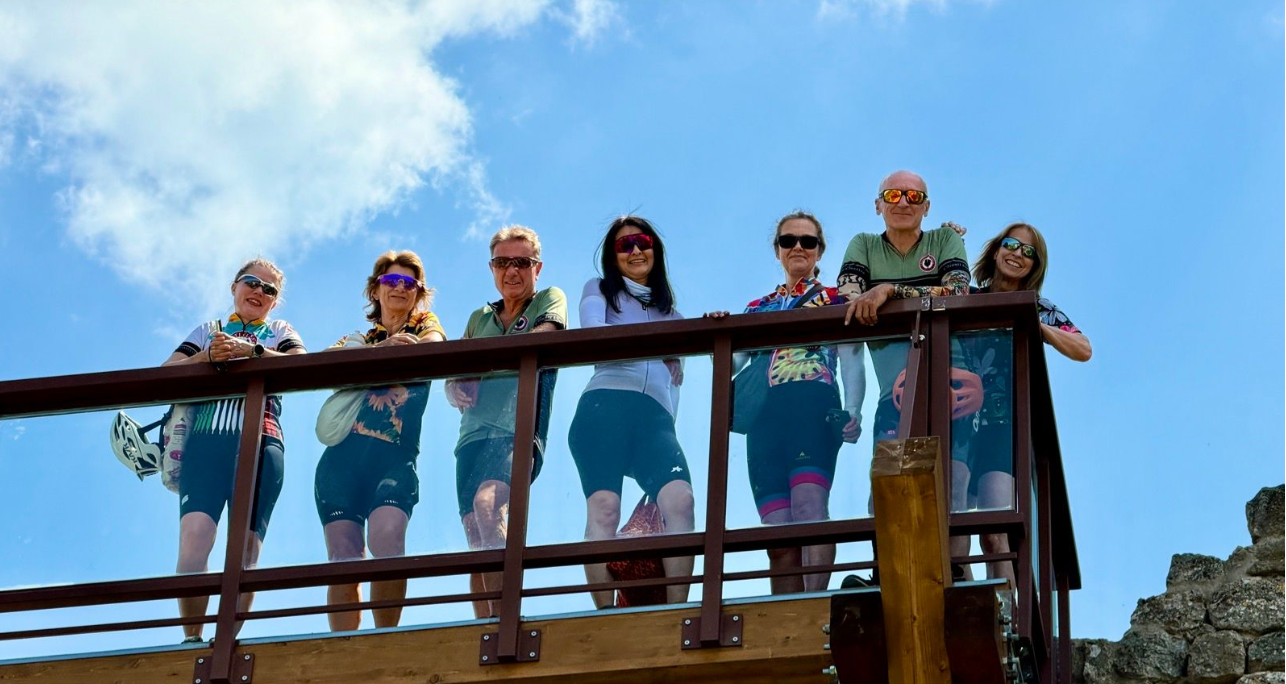
I recently returned from an eight-day cycling trip through Tuscany with a group of eight friends. We were a mixed group of men and women, and while half of us chose electric bikes, the other half bravely tackled the hills on traditional road bikes.
Our route took us from the bustling streets of Florence through the rolling hills of Chianti to the medieval hilltop town of Radda in Chianti, the beautifully preserved walled village of Monteriggioni, the famous town of San Gimignano (renowned since the Middle Ages for its high-quality saffron) where I enjoyed a memorable saffron risotto, and finally to Siena, home of the Palio, one of the world’s most famous horse races, held each year in the magnificent Piazza del Campo.
Fortunately for me, I was riding an electric bike! However, before you assume that an electric bike does all the work, let me assure you that it doesn’t.
While the battery definitely helps, it's quite heavy (mine was 35 kg or 77 lb) and holding on to it while navigating steep, impassible mountainsides on foot while making sure it doesn't go careening down the slope is a test to your shoulder and arm muscles. More importantly, you have to concentrate. On the climbs, you can't simply stop halfway up the hill. If you stop peddling, you lose momentum and risk toppling over. Restarting a heavy electric bike on a steep incline is surprisingly difficult and not something I would recommend.
On the descents, there is no opportunity to switch off either. Tuscany’s famous strade bianche, the white gravel roads that weave through vineyards and olive groves, require constant attention. Potholes, loose gravel and deep dust-filled ruts can appear without warning. A moment’s inattention can quickly lead to a fall.
There were also plenty of other distractions. Passing cars, fellow cyclists and even modern-day pilgrims walking the ancient Via Francigena route from Canterbury to Rome, first documented by the 9th-century Archbishop Sigeric the Serious (yep, really his name!).
Ironically, I found myself developing a great affection for groomed asphalt.
The smooth winding roads allowed me to coast downhill while taking in, through my peripheral vision, the iconic Tuscan landscape. Tall cypress trees lined distant ridges. Ancient olive groves shimmered in the afternoon sun. Vineyards stretched across the hillsides, while stone farmhouses sat perched above the valleys. Occasionally I would stop in a shady spot simply to absorb the view.
What struck me most about the trip was that cycling is not merely exercise. Successful cycling requires balance, coordination, reaction time, spatial awareness, muscle strength, cardiovascular fitness and constant attention. It challenges both body and brain simultaneously.
As we age, we often focus on maintaining strength and fitness, which are certainly important. But activities that combine physical movement with balance, concentration and skill may be even more valuable. Balance is not a trivial skill. It is one of the most underappreciated markers of healthy ageing.
A widely discussed study found that people in later life who were unable to stand on one leg for 10 seconds had a significantly higher risk of death over the following years. That does not mean balance itself is magical. Rather, balance reflects the integration of many systems working together, including muscle strength, vision, vestibular function, coordination, reaction time, proprioception and brain health.

Cycling through Tuscany reminded me that balance is not something we either have or do not have. It is something we continue to train.
As many of you know, at Oxford Healthspan we often talk about the twelve Hallmarks of Ageing and the role of autophagy in helping to address several of them. However, the more time I spend speaking with longevity physicians and researchers, the more I appreciate that ageing is not only happening inside our cells.
I was recently interviewed by Dr Jeffrey Gladden, a longevity physician based in Dallas, Texas. Dr Gladden is among a growing number of longevity experts who believe that two additional hallmarks deserve far greater attention: mechanical ageing and extracellular matrix ageing. As I cycled through Tuscany, I found myself thinking about both.
Mechanical aging refers to the gradual decline in the body’s ability to move efficiently through the world. It encompasses strength, balance, coordination, mobility, reaction time and resilience. As we age, our tissues become less adaptable, our reflexes may slow and our capacity to recover from physical challenges can diminish.
Extracellular matrix aging refers to changes in the vast network of collagen, elastin and connective tissue that surrounds and supports every cell in our body. The extracellular matrix is the scaffolding that helps maintain the structure and function of our skin, blood vessels, muscles, tendons, ligaments and organs.
As we age, collagen becomes increasingly cross-linked and stiff. Blood vessels lose elasticity. Tendons become less resilient. Joints become less forgiving. Much of what we experience as physical ageing is actually the ageing of this connective tissue network.
Cycling is a wonderful reminder that healthy ageing is not simply about having healthy cells. Every climb, descent and turn in the road depends upon the ability of our muscles, connective tissues, joints and nervous system to work together seamlessly.
One of the loveliest parts of the trip was that I was travelling with seven friends.
That mattered just as much as the cycling.
Healthy aging is not only about what we eat, how we move, or which supplements we take. It is also about connection. It is about laughing together, struggling up hills together, stopping for coffee together and bearing witness to one another’s lives.
Shared experiences help keep us emotionally well. Friendships give texture to life. They help us feel seen, supported and rooted in something larger than ourselves.
In Tuscany, the cycling challenged our bodies, but the companionship nourished something equally important: our sense of belonging.
As I looked out across the vineyards and cypress-lined hills, I was reminded that ageing well is not just cellular. It is physical, neurological, social and emotional.
At Oxford Healthspan, we spend a great deal of time talking about autophagy, cellular renewal and the biology of healthy aging. Those things matter enormously. Yet healthy ageing is ultimately about preserving our ability to fully participate in life.
Whether that means cycling through Tuscany, learning a new language, joining a choir, taking up dancing, travelling with friends or simply exploring somewhere new, our brains and bodies thrive when we continue to challenge ourselves, connect with others and remain engaged with the world around us.
One of the great myths of ageing is that comfort equals safety.
In reality, maintaining capability often requires us to venture slightly beyond our comfort zone.
My electric bike certainly helped me climb the Tuscan hills. But it could not maintain my balance, focus my attention, navigate the gravel roads or appreciate the beauty of the landscape.
Those skills still belonged entirely to me.
Perhaps that is one of the most important lessons of healthy ageing. Technology can support us, but it cannot replace the remarkable capabilities of a well-trained body, an engaged mind and a life enriched by meaningful relationships.
Longevity is not simply about adding years to life. It is about maintaining the ability to fully experience those years, wherever the road may lead.
Perhaps healthy aging is best measured not by how old our cells are, but by whether we can still climb the hill, enjoy the view, share the journey with friends and confidently navigate the road ahead.


Leave a comment
All comments are moderated before being published.
This site is protected by hCaptcha and the hCaptcha Privacy Policy and Terms of Service apply.