

For decades, aging research focused mainly on lifespan, how long we live. Increasingly, scientists are asking a more meaningful question: how well do we live as we age? A new clinical study now underway in the U.S. is testing whether a targeted combination of spermidine, exercise, and anti-inflammatory medicines can support healthspan alongside lifespan.
In short: A new U.S. clinical study is testing whether combining spermidine, exercise, and low-dose anti-inflammatory medicines can extend healthspan, the years we live in good health, not just lifespan. It targets inflammaging, the chronic, low-grade inflammation that builds with age and is linked to several hallmarks of aging.
The study is enrolling healthy adults aged 65 to 80 and brings together three interventions that, individually, have each shown promise in aging research:
- High-intensity interval training (HIIT) combined with resistance exercise
- The dietary supplement spermidine (as found in Primeadine)
- Low-dose anti-inflammatory medications
Inflammaging: the idea at the center of the study
Inflammaging is chronic, low-grade inflammation that develops as we age, when the immune system becomes dysregulated and stays persistently activated instead of switching on and off as needed. It is one of the processes this study is designed to address.
One of the central ideas behind this research is the concept of inflammaging [1]. As we grow older, the immune system can become dysregulated. Instead of short, targeted inflammatory responses to injury or infection, inflammation can remain persistently activated, producing low-grade, chronic inflammation throughout the body.
This chronic inflammation is not benign; it is thought to contribute to many conditions that become more common with age. Within the framework of the hallmarks of aging, inflammaging intersects with several core processes: immune dysfunction, mitochondrial decline, cellular senescence, and altered communication between cells [2].
The researchers behind the study hypothesize that reducing harmful inflammation, while preserving the immune system's ability to respond appropriately, could help slow some of the biological processes associated with age-related decline.
Step 1: Exercise
Exercise, especially when it combines cardiovascular and strength-based work, is one of the most well-supported interventions for healthy aging [3]. [CONFIRM SOURCE.] In this study, participants perform short daily sessions of HIIT interspersed with resistance training using bands or bodyweight exercises.
Regular physical activity supports many aspects of health, and, importantly for this study, it has anti-inflammatory effects: it helps modulate immune signaling, reduce visceral fat (a major source of inflammatory cytokines), and improve mitochondrial function, addressing several hallmarks of aging at once.
Step 2: Spermidine
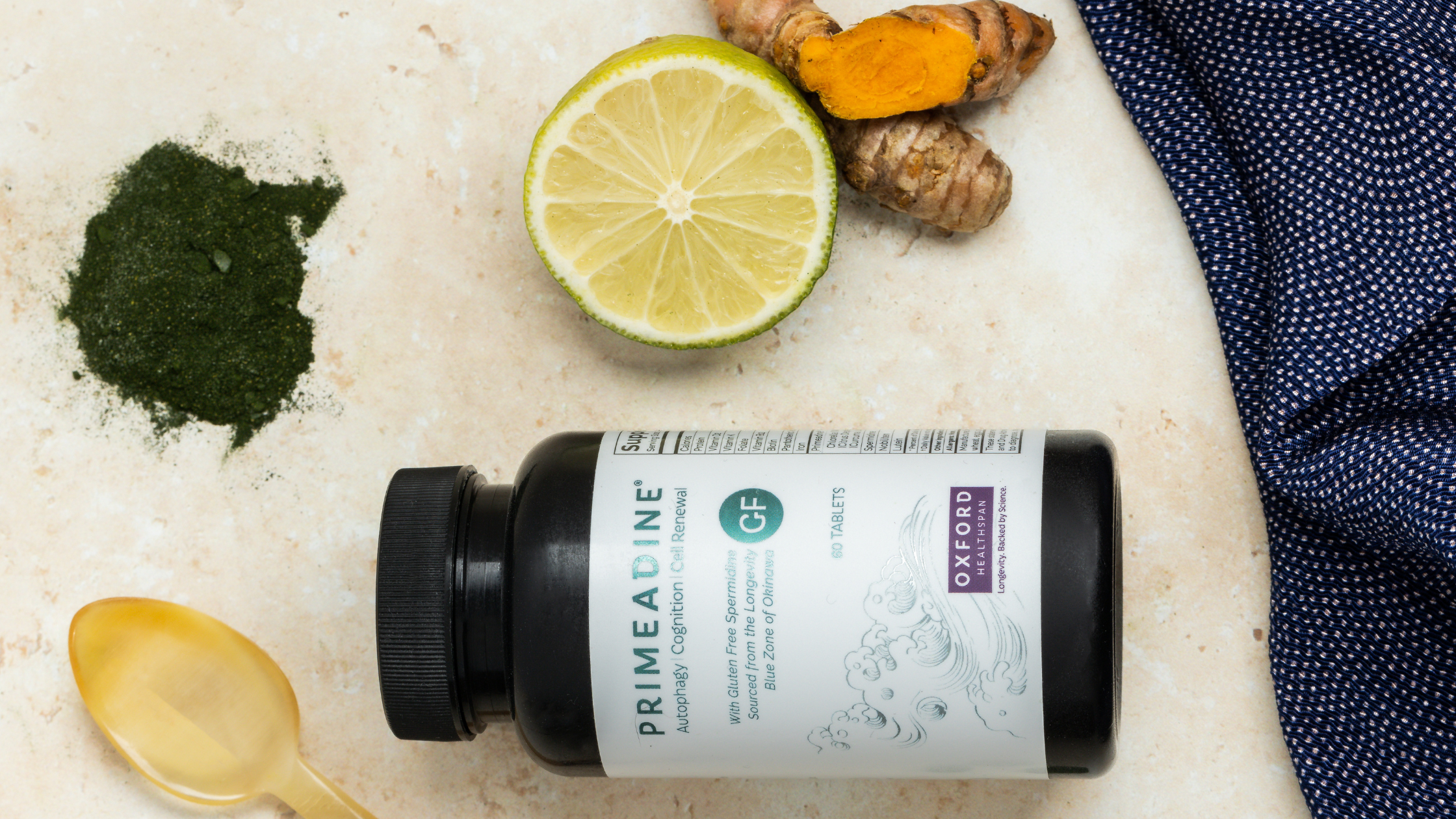
A distinctive feature of the study is the inclusion of spermidine, the naturally occurring polyamine you recognize from Primeadine. Spermidine has drawn attention in aging research for its ability to stimulate autophagy, the process by which cells recycle damaged components and maintain internal quality control [4]. You can read more about what spermidine is and how it works on our pillar page.
Autophagy declines with age, which allows dysfunctional proteins and organelles to accumulate and contribute to cellular stress and inflammation. By supporting autophagy, spermidine may help maintain cellular balance and moderate inflammatory signaling [5]. [CONFIRM SOURCE.]
Spermidine also appears to influence immune function more directly. Pre-clinical and observational studies suggest it may reduce the production of pro-inflammatory cytokines while supporting immune balance [6]. [CONFIRM SOURCE.]Spermidine levels tend to fall with age, and higher dietary spermidine intake has been associated with lower mortality in some observational population studies [7]. Building on this earlier work, the current trial is an important step toward testing spermidine's effects in a controlled, interventional setting.
Step 3: Anti-inflammatory medicines, repurposed
Alongside exercise and supplementation, participants receive one of two long-approved medications (lamivudine or rapamycin) at carefully selected doses. Both have known anti-inflammatory properties and act on immune pathways involved in aging biology [8,9].
Rapamycin, in particular, has become a focal point in longevity research because it modulates the mTOR pathway, a key regulator of growth, metabolism, and aging that is also influenced by fasting. Whether the benefits seen elsewhere can be achieved safely in healthy older adults is still an open question, and it is one this study is designed to explore.
A note on the medicines: lamivudine and rapamycin are prescription drugs used here under medical supervision within a controlled clinical trial. This article describes the study for educational purposes only and is not a recommendation to use these medicines for aging or any other purpose.
Measuring aging at the molecular level
Rather than relying only on physical outcomes, the researchers are running detailed molecular analyses throughout the year-long study. Blood samples will be examined using high-resolution proteomics, measuring thousands of immune signaling proteins to build a picture of inflammatory and immune changes over time. By mapping these shifts, the team hopes to identify biomarkers of harmful inflammation and determine whether the combined intervention meaningfully improves age-associated immune function.
A shift toward healthspan
This study reflects a broader shift in aging research toward evidence-based strategies that support healthspan, rather than chasing single-pathway cures. Spermidine features as a promising nutritional intervention, particularly when combined with lifestyle factors such as regular exercise, together targeting multiple hallmarks of aging. The work is early-stage, but it points toward an integrated approach to aging, one aimed not simply at extending lifespan, but at preserving mobility, independence, and cognitive health for longer.
This article is for educational purposes and is not medical advice. Spermidine is a food-derived nutrient, not a treatment or cure for any condition. Please speak with a qualified healthcare professional before making changes to your routine.
References
[1] Ferrucci L, Fabbri E. Inflammageing: chronic inflammation in ageing, cardiovascular disease, and frailty. Nat Rev Cardiol. 2018 Sep;15(9):505-522. doi: 10.1038/s41569-018-0064-2. PMID: 30065258; PMCID: PMC6146930
[2] López-Otín C, Blasco MA, Partridge L, Serrano M, Kroemer G. Hallmarks of aging: An expanding universe. Cell. 2023 Jan 19;186(2):243-278. doi: 10.1016/j.cell.2022.11.001. Epub 2023 Jan 3. PMID: 36599349.
[3] Izquierdo M, Fiatarone Singh MA. Evidence-based exercise enhances healthy aging. J Nutr Health Aging. 2025 Jan;29(1):100411. doi: 10.1016/j.jnha.2024.100411. Epub 2024 Dec 31. PMID: 39746235; PMCID: PMC12180035
[4] Ni YQ, Liu YS. New Insights into the Roles and Mechanisms of Spermidine in Aging and Age-Related Diseases. Aging Dis. 2021 Dec 1;12(8):1948-1963. doi: 10.14336/AD.2021.0603. PMID: 34881079; PMCID: PMC8612618
[5] Madeo F, Eisenberg T, Pietrocola F, Kroemer G. Spermidine in health and disease. Science. 2018 Jan 26;359(6374):eaan2788. doi: 10.1126/science.aan2788. PMID: 29371440.
[6] Zhang M, Caragine T, Wang H, Cohen PS, Botchkina G, Soda K, Bianchi M, Ulrich P, Cerami A, Sherry B, Tracey KJ. Spermine inhibits proinflammatory cytokine synthesis in human mononuclear cells: a counterregulatory mechanism that restrains the immune response. J Exp Med. 1997 May 19;185(10):1759-68. doi: 10.1084/jem.185.10.1759. PMID: 9151701; PMCID: PMC2196317
[7] Kiechl S, Pechlaner R, Willeit P, Notdurfter M, Paulweber B, Willeit K, Werner P, Ruckenstuhl C, Iglseder B, Weger S, Mairhofer B, Gartner M, Kedenko L, Chmelikova M, Stekovic S, Stuppner H, Oberhollenzer F, Kroemer G, Mayr M, Eisenberg T, Tilg H, Madeo F, Willeit J. Higher spermidine intake is linked to lower mortality: a prospective population-based study. Am J Clin Nutr. 2018 Aug 1;108(2):371-380. doi: 10.1093/ajcn/nqy102. PMID: 29955838.
[8] Roark KM, Iffland PH 2nd. Rapamycin for longevity: the pros, the cons, and future perspectives. Front Aging. 2025 Jun 20;6:1628187. doi: 10.3389/fragi.2025.1628187. PMID: 40620657; PMCID: PMC12226543
[9] Chen X, Wang H, Liu Y, Zhang W, Song Z. Anti-inflammatory effect of lamivudine on ulcerative colitis. Biochem Biophys Rep. 2025 Oct 22;44:102317. doi: 10.1016/j.bbrep.2025.102317. PMID: 41189640; PMCID: PMC12581620


Leave a comment
All comments are moderated before being published.
This site is protected by hCaptcha and the hCaptcha Privacy Policy and Terms of Service apply.