
What is autophagy?
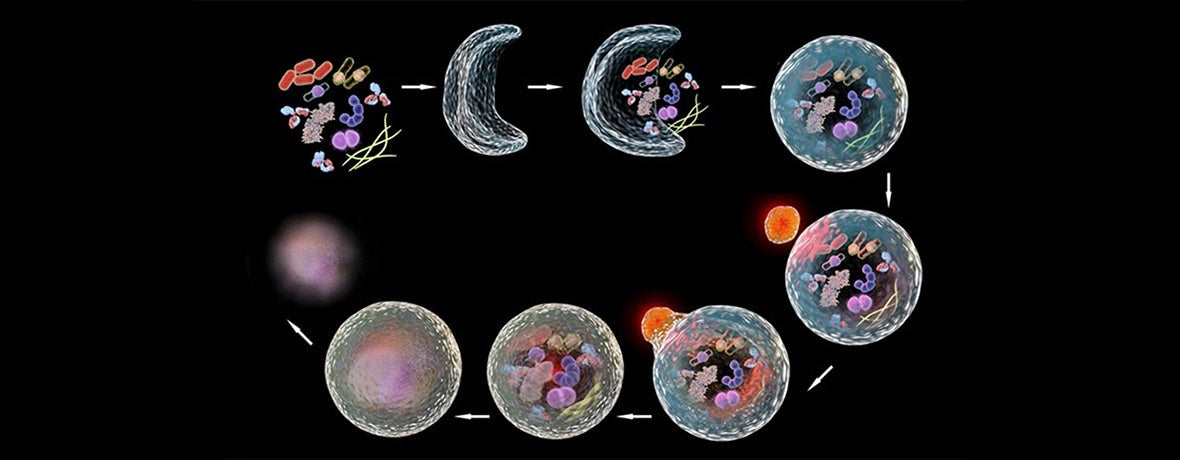
Autophagy is your body's built-in cellular recycling system. The word comes from the Greek for "self-eating": cells break down worn-out proteins, damaged mitochondria, and other debris, then reuse the parts to build new components. It is one of the main ways your cells keep themselves clean, efficient, and resilient.
Autophagy happens in almost every cell in your body, all the time, at a low background level. It ramps up when cells are under mild stress, such as during fasting or exercise, and it slows down as we age.
Its importance is hard to overstate. Japanese scientist Yoshinori Ohsumi was awarded the 2016 Nobel Prize in Physiology or Medicine for discovering the mechanisms behind autophagy, work that sparked an explosion of research into how cellular renewal shapes the way we age.
How autophagy works
Autophagy works in four main steps: a cell senses that it needs to clean up, wraps unwanted material in a membrane, delivers it to the lysosome to be broken down, and releases the raw materials for reuse. The whole process is tightly controlled by the cell's nutrient-sensing pathways.
- Sensing. When nutrients run low or a cell is under mild stress, the growth signal mTOR quiets down and the energy sensor AMPK switches on. Together, they tell the cell it is time to clean house.
- Capture. A double-layered membrane forms around damaged proteins, worn-out organelles, or other debris, creating a sac called an autophagosome.
- Breakdown. The autophagosome fuses with a lysosome, the cell's recycling center, where enzymes break the contents down into amino acids, fats, and sugars.
- Recycling. These building blocks are released back into the cell to make new proteins and fresh components, or to produce energy.
The main types of autophagy
|
Type |
How it works |
|---|---|
|
Macroautophagy |
The main form, using autophagosomes to capture larger cargo. When people say "autophagy," they usually mean this |
|
Microautophagy |
The lysosome engulfs small amounts of material directly |
|
Chaperone-mediated autophagy |
Helper proteins escort specific damaged proteins into the lysosome one at a time |
|
Mitophagy |
A selective form of macroautophagy that clears out damaged mitochondria, your cells' energy producers |
Why autophagy slows down with age
Autophagy becomes less efficient as we get older, so cellular debris builds up faster than it is cleared. Scientists now recognize this decline, called disabled macroautophagy, as one of the twelve hallmarks of aging: the core biological processes that drive how our bodies age.
When researchers updated the hallmarks framework in 2023, they added disabled macroautophagy as a hallmark in its own right. It also connects closely to several others, including loss of proteostasis, where proteins misfold and accumulate, and mitochondrial dysfunction, where worn-out mitochondria are not replaced.
Several things contribute to the slowdown. Nutrient-sensing pathways become less responsive with age, and natural levels of autophagy-supporting compounds such as spermidine decline over time. Modern habits, like eating from morning to night and moving less, give cells fewer natural prompts to clean up. Explore the full framework in our guide to the hallmarks of aging.
The benefits of autophagy for healthy aging
Autophagy keeps cells running cleanly and efficiently. By clearing damaged components and recycling them, it supports cellular energy, protein quality, immune renewal, and the everyday upkeep of tissues like skin. In short, it is one of the foundations of aging well at the cellular level.
- Cellular energy. Through mitophagy, autophagy removes worn-out mitochondria so healthier ones can take their place, supporting the energy your cells run on.
- Protein quality control. Autophagy clears misfolded and clumped proteins before they build up and interfere with normal cell function.
- Immune renewal. Immune cells rely on autophagy to stay responsive. Recent research from Oxford explores how spermidine supports immune cell renewal.
- Skin renewal. Skin cells use autophagy to manage everyday stress and stay resilient. Read more about autophagy for skin radiance and renewal.
- Metabolic flexibility. By recycling cellular components into fuel during fasting, autophagy helps cells adapt between fed and fasted states.
How to support autophagy naturally
The most effective ways to support autophagy are giving your body regular breaks from eating, exercising, sleeping well, and getting enough spermidine from food or supplements. Each one sends your cells a signal to clean up and renew, and they work best combined.
Time-restricted eating and fasting
When you stop eating for a while, falling nutrient signals switch autophagy on. Time-restricted eating, such as keeping meals within an 8 to 10 hour window, is an approachable way to build in daily breaks. Learn more in intermittent fasting and autophagy. If fasting does not suit you, there are other options: see how to induce autophagy without fasting.
Exercise
Physical activity creates the kind of mild, healthy stress that prompts autophagy in muscle and other tissues. A mix of aerobic exercise and strength training works well.
Sleep
Much of your body's repair work happens overnight, and consistent, quality sleep supports healthy cellular renewal. See the power of sleep for longevity.
Spermidine
Spermidine is a natural polyamine that induces autophagy, and it is often described as a calorie restriction mimetic because it prompts some of the same cellular clean-up as fasting. Research also shows spermidine plays a key role in fasting-induced autophagy. You can get it from spermidine-rich foods like wheat germ, soybeans, and mushrooms, or from a supplement.
Food and drink
Beyond spermidine, polyphenol-rich foods and drinks such as green tea and coffee are being studied for their effects on autophagy. Try our autophagy tea recipe or iced autophagy coffee.
Frequently asked questions
How long do you need to fast for autophagy to start?
There is no single number for humans. Autophagy is always running at a low level and increases gradually as you fast, and much of the research on longer fasts comes from animal studies. For most people, daily time-restricted eating is a more sustainable approach than extended fasting.
Can you measure autophagy?
Not easily. There is currently no simple consumer test for autophagy. Researchers measure it in the lab using tissue or blood markers, which is why lifestyle habits and spermidine intake are often used as practical proxies.
What is the difference between autophagy and apoptosis?
Autophagy is a cell recycling its own parts so it can keep functioning. Apoptosis is programmed cell death, where a whole cell is dismantled and removed. Both are normal and help keep tissues healthy.
Does spermidine induce autophagy?
Yes. Spermidine is one of the most widely studied natural inducers of autophagy, with research going back more than 15 years. Learn the basics in what is spermidine?
Can you have too much autophagy?
Autophagy is tightly regulated by your body, which balances clean-up with growth and repair. Everyday habits such as time-restricted eating, exercise, and good sleep work within that natural balance. Speak with your healthcare provider before starting extended fasts.
Support autophagy every day with Primeadine
Spermidine is one of the simplest ways to support autophagy every day, whether or not you fast. Primeadine Original delivers food-derived spermidine from defatted Japanese wheat germ, and Primeadine GF is the gluten-free version, made from Okinawan chlorella. Both are third-party tested and developed with scientific advisors from the University of Oxford to support healthy aging and cellular renewal.
This article is for informational purposes only and is not intended as medical advice. Please speak with your healthcare provider before starting any new supplement or fasting routine, especially if you are pregnant, breastfeeding, taking medication, or managing a health condition.
References
- The Nobel Prize in Physiology or Medicine 2016: Yoshinori Ohsumi. NobelPrize.org. https://www.nobelprize.org/prizes/medicine/2016/press-release/
- López-Otín C, et al. Hallmarks of aging: an expanding universe. Cell. 2023;186(2):243–278. https://doi.org/10.1016/j.cell.2022.11.001
- Mizushima N, Komatsu M. Autophagy: renovation of cells and tissues. Cell. 2011;147(4):728–741. https://doi.org/10.1016/j.cell.2011.10.026
- Eisenberg T, et al. Induction of autophagy by spermidine promotes longevity. Nature Cell Biology.2009;11(11):1305–1314. https://doi.org/10.1038/ncb1975
- Madeo F, et al. Spermidine in health and disease. Science. 2018;359(6374):eaan2788. https://doi.org/10.1126/science.aan2788


Leave a comment
All comments are moderated before being published.
This site is protected by hCaptcha and the hCaptcha Privacy Policy and Terms of Service apply.